WhatsApp Broadcast Messages: Reach 1000 Customers at Once
Last updated: 2026-01-23
Key Takeaways
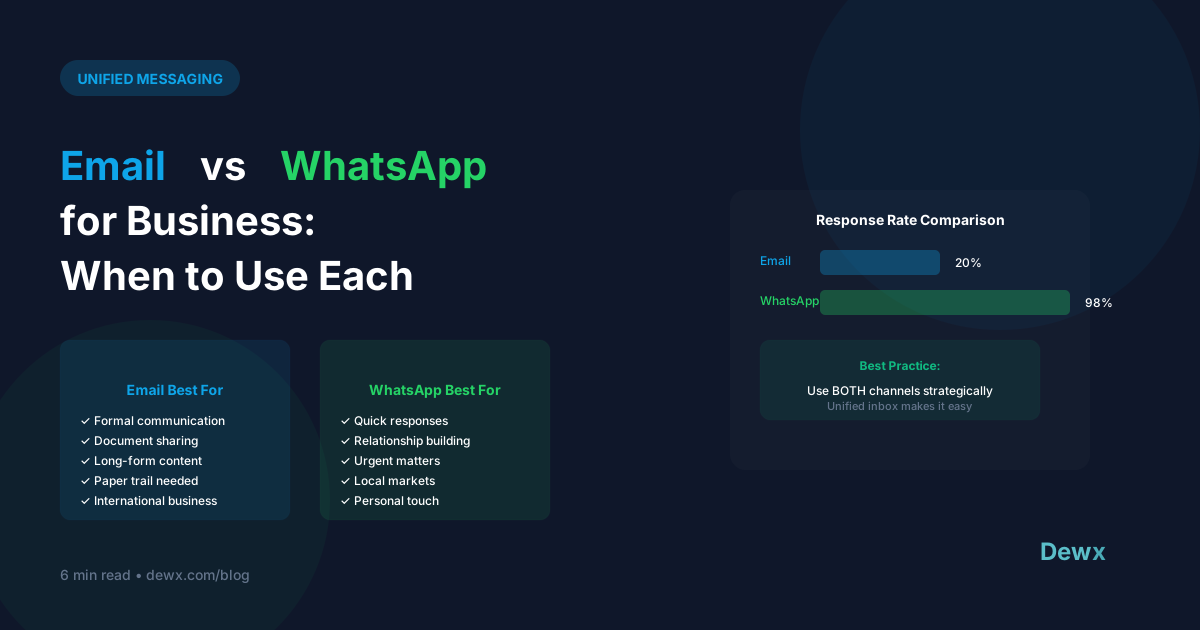
- WhatsApp broadcasts achieve 90%+ open rates compared to 20% for email newsletters
- Segmented broadcasts convert 3-5x better than mass messages
- Template messages must be pre-approved to avoid WhatsApp account restrictions
- The best broadcast strategy combines promotional and value-added content at a 20/80 ratio
Why WhatsApp Broadcasts Matters Now
The way customers communicate has changed. Instagram DMs convert at 10-15% for service businesses, outperforming feed ads by 3x. Businesses that restrict themselves to a single channel miss the majority of conversations happening on platforms they do not monitor.
The shift is not theoretical. SMS marketing generates $8.11 per message sent, making it the highest-ROI channel (Attentive 2025). The question is no longer whether to adopt multi-channel messaging but how to do it without creating chaos for your team.
Consider the typical customer journey today. A prospect discovers your business on Instagram, sends a DM asking about pricing, follows up via email two days later, and eventually books a call through WhatsApp. If each channel lives in a separate tool, you lose the thread. The businesses winning at messaging have figured out the unification layer — a single conversation history follows the customer regardless of which channel they use next.
Channel Performance Benchmarks
| Channel | Open Rate | Avg Response Time | Conversion Rate | Best For |
|---|---|---|---|---|
| 98% | < 30 sec | 45-60% | Highest engagement for 1:1 conversations | |
| 20-25% | 4-8 hrs | 2-5% | Best for long-form content and documentation | |
| SMS | 95% | < 3 min | 30-45% | Ideal for time-sensitive notifications |
| 35-50% | 1-3 hrs | 15-25% | Top B2B channel for professional outreach | |
| Instagram DMs | 70-80% | 30-60 min | 10-20% | Strong for visual and service businesses |
Channel switching costs businesses $75 per conversation in lost productivity (Twilio). The key insight is that different channels serve different purposes — the best strategy uses each channel for what it does best.
See the difference a unified platform makes. Start free with Dewx — setup takes 15 minutes.
Creating Effective Broadcasts
Phase 1: Audit Your Current Channels (Week 1)
Map every channel where customers currently reach you. Include channels you are not actively managing. AI-powered replies connects all channels into a single view so nothing falls through the cracks.
Phase 2: Prioritize by Volume and Value (Week 2)
Rank channels by message volume and revenue impact. WhatsApp Business messages achieve 98% open rates versus 20% for traditional email marketing.
Phase 3: Build Response Workflows (Week 3)
Create response templates, routing rules, and escalation paths for each channel. LinkedIn messaging channel automates most routing decisions using AI.
Phase 4: Automate and Scale (Week 4+)
Layer in automation — auto-replies for after-hours messages, trigger sequences based on customer actions, and let connect WhatsApp handle the first response for common questions. A well-configured system handles 40-60% of incoming messages without human intervention.
Compliance and Best Practices
WhatsApp: Use pre-approved message templates for outbound. Respond within 24 hours. Do not send promotional messages without opt-in.
Email: Follow CAN-SPAM requirements. Include unsubscribe links. Dewx automatically paces sending to protect deliverability.
LinkedIn: Stay within daily connection and message limits. Personalize outreach. pricing at $49/month helps maintain compliance.
SMS: Obtain explicit consent. Include opt-out instructions. Follow TCPA regulations.
Broadcast Compliance Mistakes
Mistake 1: Treating all channels the same. Each channel has its own tone, timing, and expectations. Match the medium.
Mistake 2: Not measuring channel-specific metrics. LinkedIn InMail has a 300% higher response rate than cold email for B2B outreach. Track response time, resolution rate, and satisfaction per channel.
Mistake 3: Ignoring response time expectations. Customers on WhatsApp expect replies in minutes, not hours. If you cannot meet expectations, automate initial replies.
Channel Selection Framework
Not every business needs every channel. The right mix depends on three factors: where your customers already are, what type of communication your business requires, and how much volume your team can handle.
Service businesses (consultants, agencies, freelancers) should prioritize WhatsApp and email. WhatsApp handles quick updates, approvals, and relationship maintenance. Email handles proposals, reports, and documentation. Add LinkedIn if B2B prospecting is a significant part of your growth strategy.
E-commerce and retail businesses should prioritize Instagram DMs and WhatsApp. Instagram captures purchase intent from visual discovery. WhatsApp handles order inquiries, shipping updates, and post-purchase support. Add SMS for time-sensitive promotions and delivery notifications.
B2B companies should prioritize LinkedIn and email. LinkedIn is the primary discovery and outreach channel for professional services. Email handles formal communication, proposals, and documentation. Add WhatsApp for existing client relationships where faster communication is valued.
Start with 2 channels. Add a third only after the first two are running smoothly with documented response workflows. Dew for messaging connects all channels in one click, so adding a new channel later takes minutes, not days.
Further Reading
- WhatsApp Business API Guide — official documentation for WhatsApp Business
- Zendesk CX Trends — annual customer experience trends report
- The Future of Business Messaging — McKinsey insights on digital engagement
Frequently Asked Questions
How do I avoid getting flagged as spam on messaging platforms?
Each channel has built-in compliance guardrails. For WhatsApp, use pre-approved templates for outbound messages. For email, Dewx monitors your sender reputation and paces outreach. For LinkedIn, stay within daily connection limits. The platform warns you before you approach any limit.
Does connecting channels require technical knowledge?
No. Each integration has a guided setup wizard that takes 5-15 minutes. For WhatsApp, you scan a QR code. For email, you authenticate with Gmail or enter SMTP details. No API keys or developer setup required.
How does the unified inbox handle high message volume?
The Portal uses AI-powered triage to categorize, prioritize, and route messages. Urgent messages surface first, routine inquiries get auto-replies, and team members see only the conversations assigned to them. It scales to thousands of daily messages.
Which messaging channels does Dewx support?
Dewx Portal supports WhatsApp Business API, email (Gmail, Outlook, custom SMTP), SMS, LinkedIn messaging, Instagram DMs, and Telegram. All channels feed into a single unified inbox so your team sees every conversation in one place.
Start Unifying Your Channels
WhatsApp Broadcasts does not have to be overwhelming. start your free trial and connect your first channel in under 15 minutes. Every message, every channel, one inbox.