Operational Efficiency: The SMB Playbook for Doing More With Less
Last updated: 2026-01-17
Key Takeaways
- Operationally efficient SMBs generate 40% more revenue per employee
- The biggest efficiency gains come from eliminating not optimizing processes
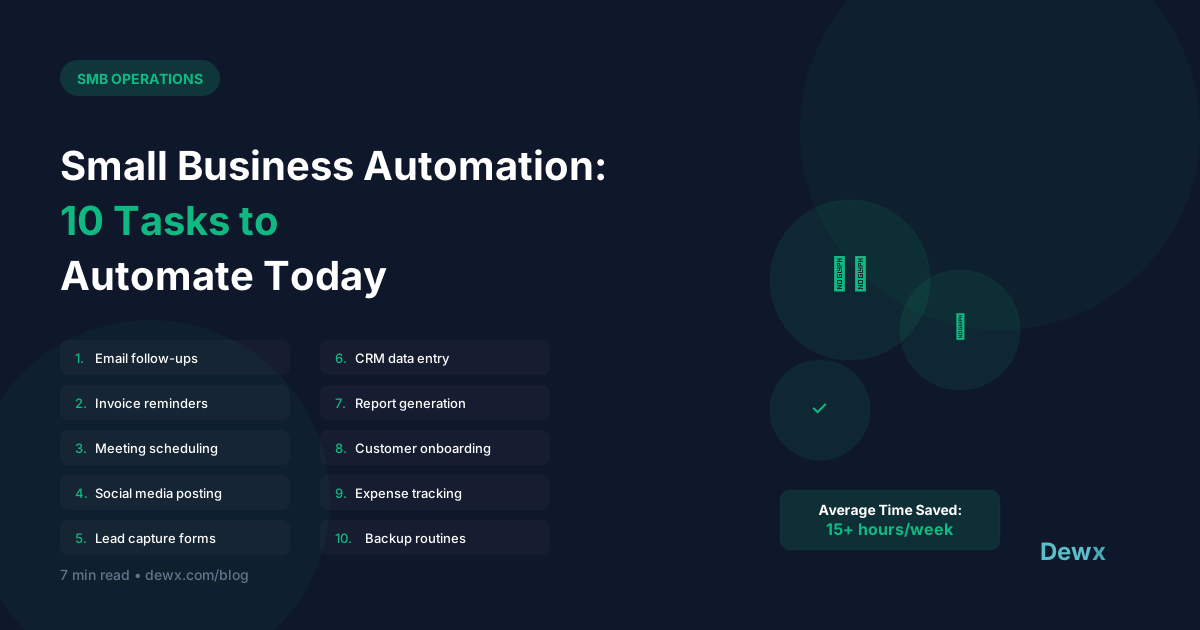
- Automation of repetitive tasks saves 15-25 hours per employee per month
- Batch processing similar tasks increases throughput by 30-50%
The Operations Problem Nobody Talks About
Small business operations are held together by willpower, spreadsheets, and late nights. Document automation saves 20-30 minutes per document versus manual creation (McKinsey). The unsexy truth is that operational inefficiency is the silent killer of otherwise good businesses.
Most SMB owners are so deep in day-to-day execution that they cannot see the waste. Businesses tracking expenses weekly are 3x more likely to hit profit targets (QuickBooks). The businesses that break through are the ones that systematize operations before they become a bottleneck.
Here is the uncomfortable truth: most SMBs are not limited by market demand or product quality. They are limited by operational capacity. The solution is not hiring more people — it is systematizing operations first, then scaling the system.
Monthly Cost Analysis: Manual vs Automated
| Cost Category | Manual (Monthly) | Automated (Monthly) | Annual Savings |
|---|---|---|---|
| Manual admin time | 60-80 hrs | 15-20 hrs | $4,500-$9,000 |
| Software subscriptions | $1,500-$3,000 | $49 | $17,400-$35,400 |
| Error correction | 10-15 hrs | 1-2 hrs | $1,350-$3,900 |
| Training new hires | 40+ hrs | 8-10 hrs | $3,000-$4,500 |
Total annual savings: $26,000-$53,000 for a small team. Employee onboarding costs average $4,700 per hire — automation cuts this by 50% (SHRM). These savings compound — saved time becomes billable capacity worth $78,000-$156,000 annually for consultants billing $150-300/hour.
Want to skip the manual work? Start your free Dewx trial and automate this today.
The Operational Efficiency Framework
Week 1: Map and Measure
Document every recurring process. Track time spent for 5 business days. You will find 40-60% of weekly work is repetitive. Operations Hub can help identify and categorize these workflows automatically.
Week 2: Automate the Highest-Impact Tasks
Start with the top 3 time-consuming tasks from your audit. Small businesses lose $11,000 per employee per year to inefficient processes (IDC).
Week 3: Build Standard Operating Procedures
Document the workflows you automated. the AI assistant provides SOP templates.
Week 4: Optimize and Measure Results
Compare metrics with Week 1 baseline. Most businesses see 40-60% improvement in the first month. the sales automation module provides dashboards for tracking operational KPIs.
OPS Hub Integration
Dewx OPS Hub handles the operational backbone in one place:
- Invoicing & payments: Automated recurring invoices, payment reminders, and overdue notifications
- Expense tracking: AI-powered receipt scanning and categorization
- Team management: Scheduling, time tracking, and task assignment
- HR basics: Leave management, onboarding checklists, and document storage
47% of SMB owners spend 40+ hours per week on administrative tasks alone (SCORE 2025). All of this connects to your CRM, messaging, and project management.
Pro Tip: Ask Go-to-Market Hub to set up operational workflows in plain language.
Efficiency vs Quality Trade-Offs
Mistake 1: Automating a broken process. Fix the process first, then automate.
Mistake 2: Not involving the team. The people doing the work know where the bottlenecks are.
Mistake 3: Skipping measurement. Without baseline metrics, you cannot prove ROI. the agency replacement.
Further Reading
- SCORE Mentoring & Resources — free business mentoring and workshops
- McKinsey Operations Insights — operational excellence frameworks
- The E-Myth Revisited Principles — why most small businesses fail and how to fix it
Frequently Asked Questions
Will automation replace my need for an accountant or bookkeeper?
Not entirely, but it dramatically reduces the work they need to do. Automated expense categorization, receipt scanning, and reconciliation handle 80% of the routine work. Your accountant focuses on strategy, tax planning, and compliance review instead of data entry.
How long does it take to set up operational workflows?
Basic workflows like automated invoicing, expense tracking, and team scheduling can be configured in 1-3 days. More complex workflows involving multi-step approvals or custom integrations typically take 1-2 weeks to fully optimize.
Is this practical for a team of fewer than 5 people?
Small teams benefit the most because each person wears multiple hats. Automating routine tasks for a 3-5 person team effectively adds the productivity equivalent of 1-2 additional team members. The ROI is typically visible within the first month.
Start Streamlining Operations
learn how it works and set up your first automated workflow in under 30 minutes.