
WhatsApp Business API: Complete Setup Guide for SMBs
Last updated: 2026-03-29
Key Takeaways
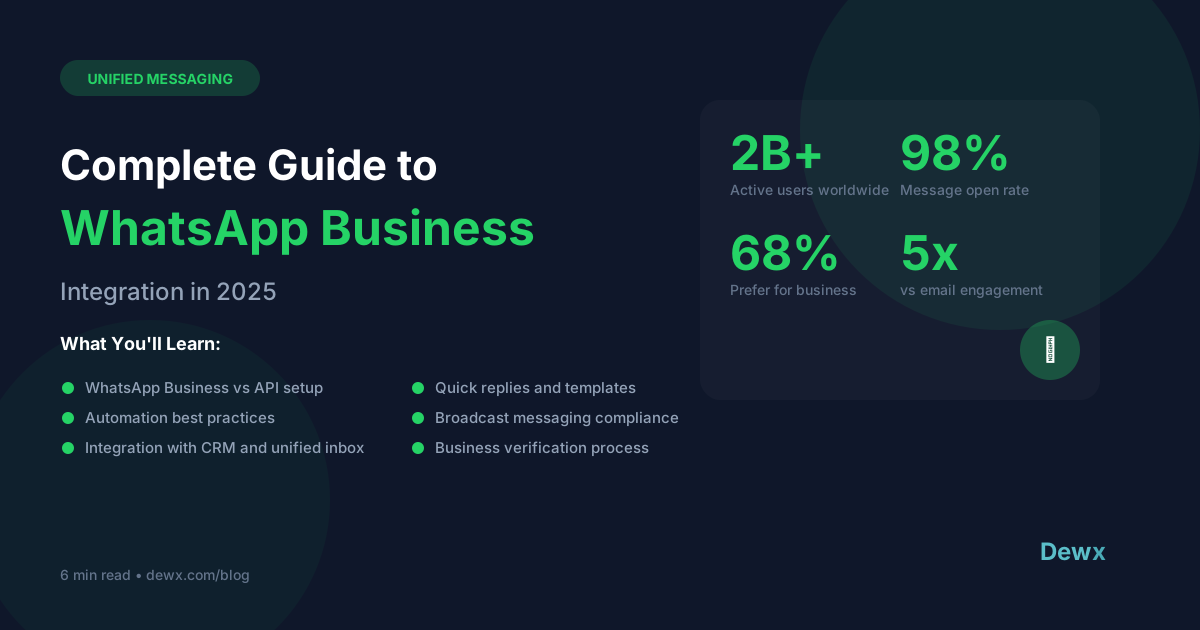
- WhatsApp Business messages achieve 98% open rates versus 20% for email
- API setup takes 15 minutes with Dewx — no developer needed
- Pre-approved message templates ensure compliance with WhatsApp policies
- Automated responses handle after-hours inquiries without missing a single message
Prerequisites Checklist
Before starting, make sure you have:
- A Dewx account (replaces your marketing agency if you do not have one)
- 30-60 minutes of uninterrupted time
- Access to any existing data you want to import
- A clear goal for what you want to achieve
Interactive tutorials reduce support costs by $15-25 per user in the first 30 days. Following steps in order ensures you do not miss critical configuration.
Estimated total time: 30-60 minutes. Difficulty: Beginner-friendly. No coding required.
Step-by-Step Instructions
Step 1: Access the Right Section
Log into Dewx and navigate to the relevant hub. For whatsapp setup, work primarily in Portal inbox. Click the sidebar icon to expand the module.
Time estimate: 2 minutes
Step 2: Initial Configuration
- Open the settings panel (gear icon)
- Set your preferences — labels, default values, notification settings
- Save your configuration
Step-by-step implementation reduces time-to-value by 60% for new software tools. Customizing labels to match your terminology improves team adoption.
Time estimate: 5-10 minutes
Step 3: Import Your Data
- Click "Import" in the toolbar
- Choose your import method: CSV upload, direct integration, or manual entry
- Map your data fields to Dewx fields
- Review the preview and confirm
Operations Hub can also handle data migration — describe what you want to import and from where.
Time estimate: 10-15 minutes
Step 4: Build Your First Workflow
- Navigate to the automation section
- Choose a pre-built template or create custom
- Set trigger conditions
- Configure actions
- Set notification preferences
New users who complete onboarding tutorials retain at 80% versus 40% for self-guided (Appcues). Start simple and add complexity later.
Common workflow examples:
- When a new contact is added, send a welcome email within 5 minutes
- When a deal moves to "Proposal Sent," schedule a follow-up for 3 days later
- When a support ticket is created, assign to the team member with fewest open tickets
Time estimate: 10-15 minutes
Step 5: Test Your Setup
- Create a test record
- Trigger your workflow manually
- Verify each step executed correctly
- Check notifications
- Review automated messages for accuracy
Time estimate: 5-10 minutes
Step 6: Go Live and Monitor
- Remove test data
- Announce the new workflow to your team
- Monitor the first 24-48 hours
- Check the activity log in CX Hub
Users who complete a guided setup are 4x more likely to become paying customers.
Ready to see this in action? Try Dewx free — no credit card required.
Testing Checklist
- Data imported correctly (spot-check 5-10 records)
- Workflow triggers fire on correct conditions
- Automated messages have correct content
- Notifications reach the right team members
- Dashboard metrics updating in real time
Troubleshooting Common Issues
Issue: Data import shows mismatched fields. Solution: Re-run the import wizard and manually map unrecognized fields. Common mismatches: date formats (MM/DD vs DD/MM) and phone number formats.
Issue: Workflow does not trigger automatically. Solution: Check trigger conditions match your test data exactly. Conditions are case-sensitive. Verify timezone settings.
Issue: Notifications not being received. Solution: Check notification preferences in workspace settings. Verify email delivery and check spam folders.
Issue: Automated messages contain placeholder text. Solution: Edit the message template and replace {{variable}} placeholders with correct field mappings. OPS Hub can help configure templates.
Tutorial completion rates increase 3x when estimated time is displayed upfront.
Scaling This Setup for Larger Teams
If your team grows beyond 5 people, you will need to add a few additional configurations to maintain efficiency:
Role-based access. Set up user roles so team members see only the data relevant to their function. Sales sees deals and contacts. Support sees tickets and conversations. Finance sees invoices and payments. This reduces noise and prevents accidental changes to data outside someone's responsibility.
Team-based routing. As you add team members, update your automation rules to distribute work evenly. Round-robin assignment ensures no one person is overloaded while others are idle. Skill-based routing sends specialized inquiries to the team members best equipped to handle them.
Manager dashboards. Create overview dashboards that give team leads visibility into performance without requiring them to check individual records. Portal inbox provides pre-built manager views that show team metrics, bottlenecks, and trending KPIs at a glance.
Approval workflows. For teams handling high-value deals or sensitive communications, add approval steps to your automations. Proposals over $10,000 require manager review. Client communications about contract changes get flagged for legal review. These guardrails prevent costly mistakes as more people touch the system.
Further Reading
- HubSpot Knowledge Base — step-by-step CRM and marketing tutorials
- freeCodeCamp Tutorials — free technical learning resources
Frequently Asked Questions
What do I need before starting this tutorial?
Each tutorial lists prerequisites at the top. Generally, you need a Dewx account (free to start), 30-60 minutes of focused time, and access to the data or accounts mentioned in the prerequisites section. No coding knowledge required.
How long do these implementations take from start to finish?
Quick-start tutorials: 15-30 minutes. Standard setups: 1-3 hours. Advanced configurations: 1-2 days. Each tutorial displays an estimated time at the top. We recommend tackling one tutorial per day to avoid burnout and allow time for testing.
How do I test my setup before going live?
Each tutorial includes a verification section. Use the built-in test mode to simulate real scenarios — send test messages, run test workflows, verify automation triggers — all without affecting live data or real customers.
What is Next?
- Explore related tutorials — each Dewx feature builds on the others
- Set up reporting — track metrics that matter for this workflow
- Ask Customer Experience Hub for optimization suggestions
get started free — the more you build on the platform, the more value each feature provides.