Customer Journey Mapping for Small Businesses
Understanding your customer's journey reveals opportunities you're missing. Here's how to map it.
What is Customer Journey Mapping?
A visual representation of every interaction a customer has with your business, from first awareness to ongoing relationship.
Why It Matters:
- Identify pain points
- Find improvement opportunities
- Align team around customer experience
- Prioritize investments
The Simple Journey Map
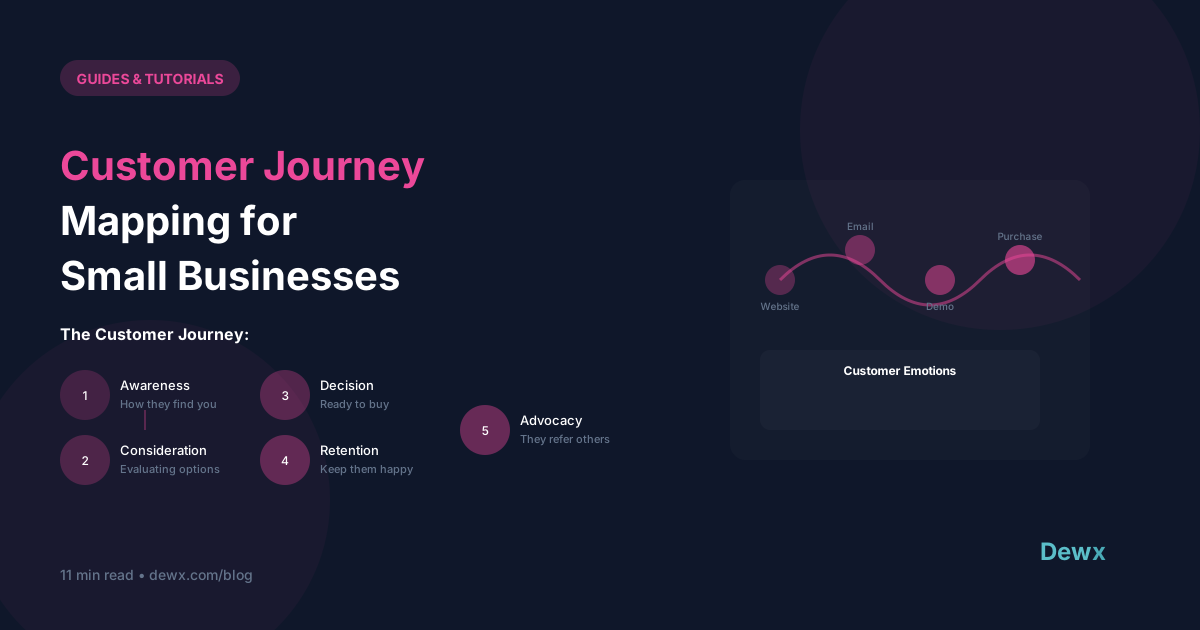
5 Stages
1. Awareness How do they first learn about you?
- Google search
- Social media
- Referral
- Advertising
2. Consideration How do they evaluate you?
- Website visit
- Reviews research
- Competitor comparison
- Content consumption
3. Decision How do they become a customer?
- Sales conversation
- Demo/trial
- Purchase process
- Onboarding
4. Experience How do they use your product/service?
- Ongoing service
- Support interactions
- Results achieved
5. Loyalty How do they become advocates?
- Repeat purchase
- Referrals
- Reviews
- Feedback
Creating Your Journey Map
Step 1: Define Your Customer
Who are you mapping for?
- Create a simple persona
- Name, role, goals, challenges
- One map per distinct customer type
Step 2: List Touchpoints
For each stage, list every interaction:
Awareness:
- Google search
- Social media post
- Referral conversation
- Advertisement
Consideration:
- Website homepage
- Pricing page
- Blog/content
- Reviews (Google, etc.)
And so on for each stage.
Step 3: Capture Customer Experience
For each touchpoint:
- What are they doing?
- What are they thinking?
- What are they feeling?
- What friction exists?
Step 4: Identify Opportunities
Look for:
- High-friction moments
- Emotional low points
- Drop-off points
- Missing touchpoints
Step 5: Prioritize Improvements
Rank opportunities by:
- Impact on customer
- Ease of implementation
- Cost/resource required
Journey Map Template
| Stage | Touchpoint | Action | Thought | Feeling | Opportunity |
|---|---|---|---|---|---|
| Awareness | Google Search | Searches "[problem]" | "How do I solve this?" | Frustrated | Better SEO for problem terms |
| Consideration | Website | Reads homepage | "Can they help me?" | Curious | Clearer value proposition |
| Decision | Sales call | Discusses needs | "Is this worth it?" | Cautious | Better objection handling |
Using Your Journey Map
Align Your Team
Share with everyone. Create shared understanding of customer experience.
Guide Improvements
Use as prioritization framework. Focus on biggest friction points.
Measure Progress
Track metrics at each stage. Are improvements working?
Update Regularly
Journey evolves. Review quarterly.
Quick Wins from Journey Mapping
Common Discoveries:
- Awareness: Missing key search terms
- Consideration: Website doesn't answer top questions
- Decision: Follow-up is inconsistent
- Experience: Onboarding is confusing
- Loyalty: Not asking for referrals
Easy Fixes:
- Add FAQ to website
- Create onboarding checklist
- Implement systematic follow-up
- Send feedback requests
- Ask happy customers for reviews
Tools for Journey Mapping
- Simple: Whiteboard, sticky notes
- Digital: Miro, Lucidchart, Notion
- Integrated: CRM with journey tracking
Dewx tracks the customer journey automatically through your unified inbox and CRM, showing you the complete picture without manual mapping.
Frequently Asked Questions
How detailed should a journey map be?
Start high-level with major stages and touchpoints. Add detail only where you're investigating specific problems. An overly detailed map becomes unwieldy and outdated quickly. Focus depth on the stages where you're losing customers or want to improve.
Who should be involved in journey mapping?
Customer-facing team members: sales, support, success. Include at least one actual customer if possible. Leadership provides strategy context. Avoid mapping in isolation—diverse perspectives reveal blind spots.
How do I gather data for journey mapping?
Customer interviews (best source), support ticket analysis, sales call reviews, analytics data (website, email), surveys, and session recordings. Combine qualitative insights (how customers feel) with quantitative data (what they do).
How often should journey maps be updated?
Review quarterly, update when things change materially: new product features, changed processes, or significant feedback. Journey maps are living documents. An outdated map is worse than no map—it gives false confidence.
What's the biggest journey mapping mistake?
Mapping what you want the journey to be, not what it actually is. Be honest about friction points, even when they're embarrassing. The map's value comes from identifying real problems, not painting a flattering picture.
See your customer journey clearly. Try Dewx free and track every touchpoint automatically across all channels.
Related: CX Hub overview | Customer retention guide